Frequently Asked Questions (FAQ)
Find answers to common questions about ZHUART Bamboo products
Product Dimensions & Customization
1. What product lengths are available?
The maximum length we can currently produce is 4200 mm.
Standard and commonly used lengths are 1850 mm, 1860 mm, 2000 mm, and 2440 mm. Lengths other than the standard sizes can be customized, provided they do not exceed 4200 mm.
2. What widths are available?
Our bamboo panels are first hot-pressed into large boards and then cut into finished profiles.
Maximum board blank width is 1260 mm (board blank only, not a finished product). Maximum sanding width is 600 mm. Standard decking widths are 65 mm, 100 mm, and 137 mm (most commonly used). Maximum decking width is 208 mm.
3. What thicknesses are available?
Board blank thickness options: 21 mm, 23 mm, 33 mm, 43 mm, 53 mm, 63 mm. Standard thicknesses for wall cladding: 8 mm, 12 mm, 14 mm, 18 mm, and 20 mm. Standard thicknesses for decking: 18 mm, 20 mm, 21 mm, 25 mm, 30 mm, and 40 mm. Standard thicknesses for panels and beams: 18 mm, 20 mm, 30 mm, 40 mm, 50 mm, 60 mm.
For other one-time molded custom thicknesses, feasibility must be confirmed with production.
4. Are products available from stock? What is the lead time?
Most standard products are available from stock.
If stock is insufficient, standard products typically require around 7 days for production. For customized products, lead time will be confirmed by the factory based on actual specifications.
Color & Appearance
5. What colors are available?
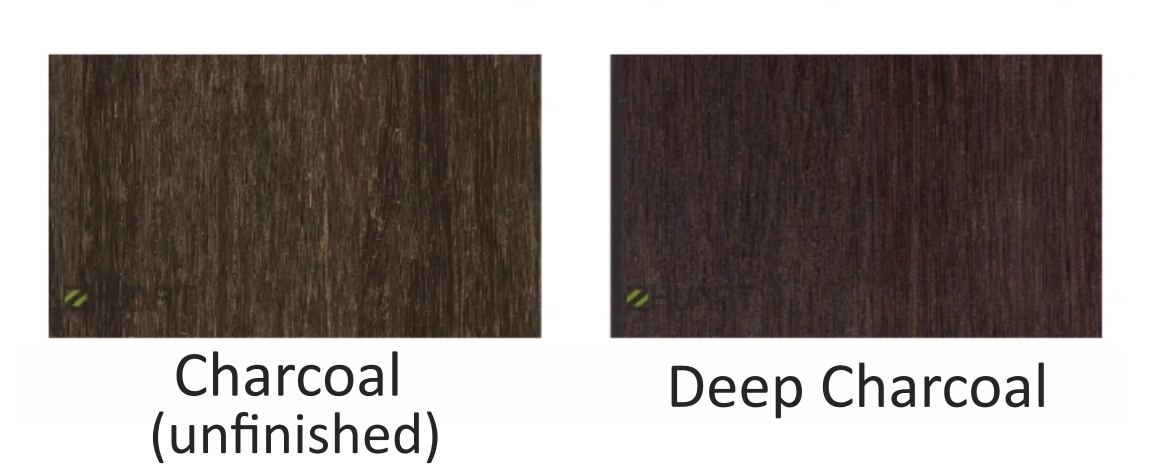
ZHUART Thermo Bamboo is available in two collections.
(1) Deep Carbon Series: Charcoal is the untreated color after high-temperature treatment; Deep Charcoal is oiled finish.
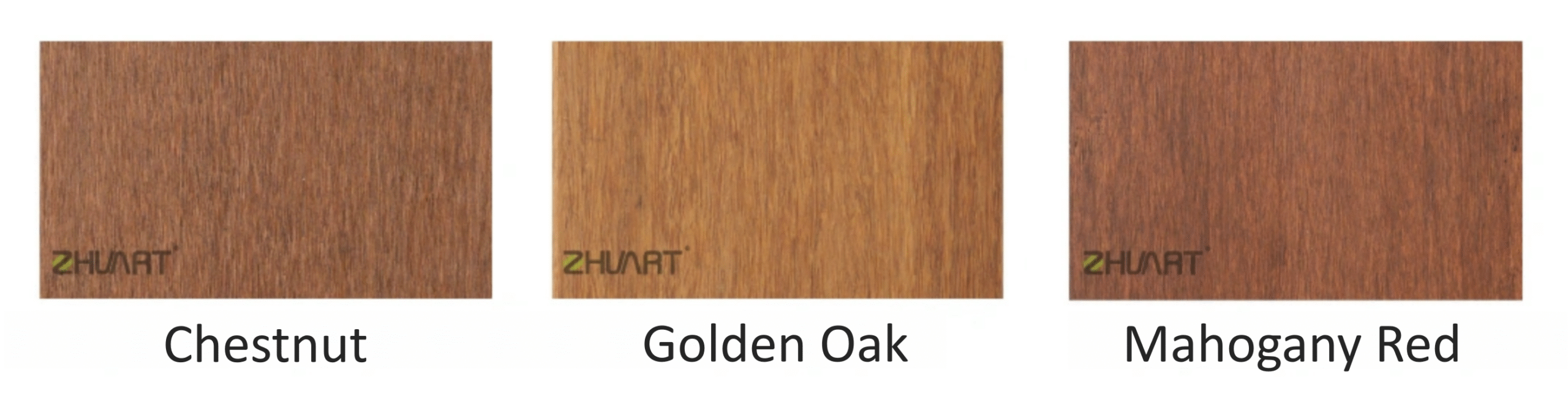
(2) Light Carbon Series: Main colors are Chestnut and Golden Oak. Other colors can be customized.
6. Will there be color variation?
Yes, slight color variation is normal.
ZHUART products are made from 4–6 year old natural bamboo. Variations may occur due to bamboo age, growing region, and sunlight exposure. Although the bamboo fibers undergo thermal modification, complete color uniformity cannot be guaranteed.
Surface oiling can help achieve a more consistent appearance.
Raw Materials & Manufacturing
7. What raw material is used for ZHUART products?
Our products are made from reconstituted natural Moso bamboo, with approximately 88% bamboo and 12% phenolic resin.
We use 4–6 year old Moso bamboo, which offers more uniform material properties and better long-term stability. Only the bamboo fiber layer (bamboo meat) is used, as it has the most consistent structure and optimal bonding performance.
8. What type of phenolic resin is used?
We use Dynea™ phenolic resin, which complies with strict environmental and safety regulations of the EU and the US. Dynea’s resins are well known for their low emissions and exceptional bonding performance in structural outdoor applications.
9. Is the bamboo crushed into powder?
No. The bamboo is processed into bamboo fibers or strands, not powder. This method preserves the natural flexibility and strength of bamboo more effectively.
10. What is the difference between Deep Carbon and Light Carbon products?
Deep Carbon products undergo longer and more intense thermal treatment — vacuum carbonization at above 220°C, leading to enhanced uniformity in color and long-term stability. Light Carbon is treated at lower temperatures — steam carbonization at ~100°C.
Thermo Bamboo | Modulus of Elasticity | Bending Strength Parallel to Grain | Hardness Brinell |
Deep Carbon | 22680 N/mm² | 129 N/mm² | 160 N/mm² |
Light Carbon | 12340 N/mm² | 111 N/mm² | 180 N/mm² |
11. What is the difference between new-generation Light Carbon and traditional Light Carbon products?
In 2021, ZHUART developed its new-generation Light Carbon products as an upgrade to traditional light carbon bamboo materials using a completely revised process. Key improvements include raw material selection, fiber separation standards, carbonization temperature, adhesive impregnation, and post-molding anti-mold treatment. This significantly improves mold resistance and durability compared with traditional light carbon products.
Durability & Performance
12. Does the material absorb water?
The surface may become wet, but the material does not absorb water like natural wood. Through thermal modification, hydrophilic hydroxyl groups are reduced, effectively controlling water absorption in outdoor environments.
13. Will the material crack?
Large cracks like those found in solid wood will not occur. Very fine hairline cracks may appear, which are considered normal.
However, any crack that penetrates through the entire thickness, is wider than 1mm, and longer than 20cm would be considered a product quality issue.
14. Will the material deform?
Over long-term use, slight dimensional changes may occur, mainly minor expansion in thickness or width. These changes are generally not visible to the naked eye. Severe deformation, splitting, or breakage will not occur unless caused by external damage.
15. Will the product develop mold?
(1) Deep Carbon products do not mold themselves. Surface mold may occur due to external environmental factors, but it can be easily wiped off.
High-temperature vacuum treatment above 220°C fully degrades nutrients such as sugars and carbohydrates, preventing mold growth.
(2) Light Carbon products may still have residual nutrients and therefore a higher mold risk depending on installation season and environment. The new-generation Light Carbon products have significantly improved mold resistance and durability.
16. Can the product be used in coastal environments?
Yes. Coastal environments are among the most demanding outdoor conditions due to salt and humidity. ZHUART thermo bamboo have been successfully used in Sanya (China), Maldives, Amsterdam (Netherlands). Performance in these environments has been very good.
Surface Treatment & Maintenance
17. Will the surface oil fade?
Surface oil fading occurs over time and is considered normal.
Due to the high density of the material (approximately 1.15 g/cm³), oil penetration is limited to the surface. We use water-based exterior oil, which have lower adhesion compared to indoor sealed coatings.
18. How often is maintenance required?
Residential use: once per year recommended
Commercial projects: based on the owner’s maintenance preferences
For a “like-new” appearance: oil every 6 months
To achieve a natural weathered look: oiling is optional and may be omitted
19. What is the recommended maintenance procedure?
Step 1: Clean surface dirt and residue with water.
Step 2: Let the boards dry fully.
Step 3: Apply water-based exterior oil or WOCA oil. Recommended consumption: 30–50 g/m².
Learn more: Maintenance Guide
20. What maintenance oil is recommended?
We recommend WOCA oil.
With annual maintenance, the oil gradually penetrates the surface, making the boards smoother and richer in appearance over time.
Other water-based exterior oils or hard wax oils may also be used but should be applied in thin layers only.
Installation Requirements
21. Can the boards be installed without gaps?
No. Thermal expansion and contraction require installation gaps:
Minimum gap between boards: 3 mm
End-to-end gap: 0.5 mm
Light Carbon products require slightly larger gaps (up to 1 mm) due to higher expansion rates.
22. Is oiling required after installation?
No, additional oiling is not required. Our products come pre-oiled from the factory (except for unfinished products).
23. Is protection required during installation?
The material is designed for outdoor exposure, and over-protection may trap moisture and negatively affect performance.
During installation, temporary protection mats may be used to prevent scratches from tools. However, all coverings must be removed after work each day to allow the boards to breathe.
Warranty
24. What is the warranty period?
(1) Deep Carbon products are supplied with a 15-year warranty.
These products have been in continuous production since 2011 and represent our most mature and proven material. As reference, projects installed in 2012 are still in use today without material replacement. The material becomes smoother with more foot traffic.
(2) The new-generation Light Carbon products are supplied with a 5-year warranty.
This product line was developedin 2021 as an upgrade to traditional light carbon bamboo materials. The warranty period is determined based on actual application performance rather than on laboratory test results. This reflects our conservative and application-oriented approach to warranty commitments for newly developed materials.